

Choose the right micromanipulator for your in vivo electrophysiology setup

by Scientifica
From multielectrode recordings to in vivo patch clamp, selecting the right micromanipulator is critical for stable recordings, precise targeting, and efficient workflows.
In vivo electrophysiology experiments typically require a probe to be positioned within a living sample, often where the probe tip itself is not visible. To achieve this, probes are mounted onto a micromanipulator positioned close to the preparation.
Historically, many researchers relied on manual, hand-controlled micromanipulators. However, increasingly demanding workflows — including high-density multielectrode recordings such as Neuropixels, multiple insertion sites, and multi-probe experiments — alongside the fragility and cost of modern probes, are driving the need for more precise, motorised probe positioning.
This guide will help you identify the right setup for your application.
Key factors to consider
In modern in vivo workflows, available space around the preparation, probe positioning accuracy, and insertion control can all have a major impact on recording quality and ease of use.
Once your application is defined, most decisions come down to a few practical constraints.
Consideration |
Why it matters |
Precision & insertion control |
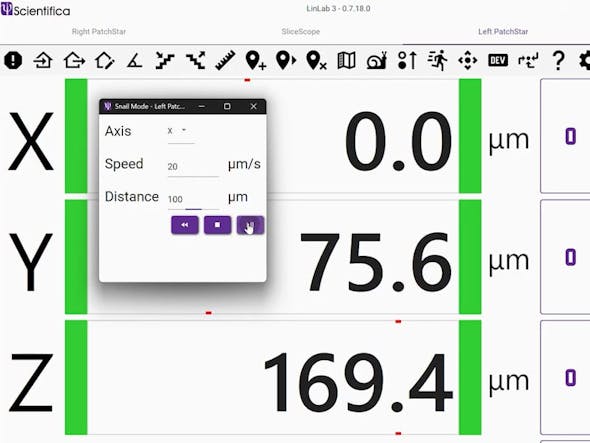
Smooth, slow insertion helps minimise tissue damage and improve targeting accuracy in applications such as high-density multielectrode recordings (e.g. Neuropixels) and patch clamp. Scientifica manipulators incorporate “Snail Mode” within the full software control of LinLab for precise controlled insertion. |
Travel range |
Larger animal models and deeper targets require increased travel range and positioning flexibility. |
Footprint |
Compact systems integrate more easily into dense multi-probe and space-constrained setups, helping reduce interference between manipulators and improving access around the preparation. |
Axis control |
Z-axis is commonly used for insertion, while XYZ supports mapping and flexible positioning workflows. |
Noise |
Ultra-low acoustic and electrical noise support cleaner recordings and sensitive experiments. Scientifica systems have even been used in echolocation studies in bats. |
Integration |
Compatibility with stereotaxic frames, manual stages, and existing rigs simplifies setup. Scientifica manipulators also support custom software integration, including Python and Matlab-based workflows. |
Match your research to the right micromanipulator
In many in vivo set ups, the choice of micromanipulator comes down to three key considerations:
- required travel range
- level of motorised control
- available space around the preparation
Scientifica’s in vivo micromanipulators are designed specifically for demanding electrophysiology workflows, combining precise motorised control with compact, ultra-low-noise designs that integrate easily for complex experimental setups.
System |
Best for |
Key advantage |
Typical setup |
Larger animal models and deeper targets |
Extended travel range (~70 mm) with precise motorised Z-axis control |
Mounted to stereotaxic frame for deeper positioning workflows |
|
Brain mapping and flexible positioning workflows |
Full motorised XYZ control with extended travel (~70 mm) |
Mounted to stereotaxic frame or breadboard mount for multi-axis positioning for mapping and flexible targeting experiments. |
|
Multi-probe and small animal model work |
Compact footprint for dense, space-constrained setups with ~20 mm travel |
Positioned around stereotaxic frames in multi-probe and high-density multielectrode recording workflows (e.g. Neuropixels). |
|
Complex multi-manipulator setups |
Extended reach and positioning flexibility for challenging configurations |
Positioned on breadboard or (magnetic) post & platform for advanced setups requiring multiple manipulators and flexible positioning. |
Choosing between Single and Triple
- Single-axis systems are commonly used for controlled probe insertion where X/Y positioning is handled manually via a stereotaxic frame.
- Triple-axis systems provide full motorised XYZ control for mapping experiments and flexible positioning workflows. The motorisation adds critical precision as the manipulators have 20nm electronic resolution and 0.1 micron positioning precision.
Choosing between Mini and IVM
- IVM Mini systems prioritise compact footprints for dense multi-probe and space-constrained setups.
- IVM systems provide increased travel range for deeper targets and larger animal models.

Scientifica IVM Triple
Motorised XYZ in vivo electrophysiology micromanipulator with extended travel range for brain mapping and flexible positioning workflows.

Scientifica IVM Mini Triple
Compact XYZ in vivo electrophysiology micromanipulator for multi-probe recordings and flexible positioning in dense experimental setups.

Scientifica IVM Single
Single-axis motorised in vivo electrophysiology micromanipulator with extended travel range for precise probe positioning and larger animal model workflows.

Scientifica IVM Mini Single
Compact single-axis in vivo electrophysiology micromanipulator for multi-probe and space-constrained stereotaxic workflows.

Scientifica InVivoStar Micromanipulator
Advanced in vivo electrophysiology micromanipulator with extended reach and flexible positioning for complex multi-manipulator workflows.
Typical in vivo electrophysiology setups
Understanding how these systems are used in practice can help guide your decision.
Workflow |
Typical configuration |
High-density multielectrode recordings (e.g. Neuropixels) in small animal models |
1–2 × IVM Mini Single mounted to stereotaxic frame |
Multi-probe recordings |
Multiple IVM Minis arranged around stereotaxic frame or breadboard |
Brain mapping |
IVM Triple or Mini Triple for precise XYZ positioning |
Larger animal work |
IVM Single or Triple for increased travel range |
Complex multi-manipulator setups |
Combination of systems or InVivoStar |
Common mistakes to avoid
Underestimating the problems with hands-on control
- Manual positioning can introduce vibrations into the tissue and make precise insertion more difficult. Motorised remote control helps minimise user-induced movement and allows researchers to focus on accurate probe positioning during insertion.
Choosing a system that’s too large
- Oversized micromanipulators can limit access around the preparation and make integration with stereotaxic frames difficult. Scientifica’s IVM Mini range is designed for space-constrained setups and workflows requiring multiple manipulators.
Not planning how everything fits together
- Consider how manipulators, frames, probes, and other equipment interact before purchasing. Scientifica micromanipulators are designed for integration with common stereotaxic frames and support custom software workflows, including Python and Matlab, alongside full hands-off control via LinLab software.
Relying on unstable mounting solutions
- Custom or improvised mounts can introduce drift and vibration, which are critical issues at micrometre precision. The mounting solution can be as important as the micromanipulator itself. Scientifica manipulators support mounting across a range of stereotaxic frames, breadboards, and accessories.
Ignoring acoustic noise
- Manipulator noise can interfere with sensitive recordings and behavioural studies. Scientifica IVM and InVivoStar systems are designed for ultra-quiet operation and have even been used in echolocation studies in bats.
Focusing on specs instead of usability
- A system that fits your workflow will often outperform one that simply offers more range or axes. Our team can help identify the right configuration for your current workflow while supporting future experimental needs.
"I have worked with the Scientifica IVM for spinal in vivo recording for years, and it has never failed me. Being able to control the descent of the electrode to the micrometer allows for an invaluable precision, and the ability of using a manual or automated control of the micromanipulator is perfect for the technique."
Dr Clemence Giere Saint Louis UniversityNeed help configuring your setup?
Choosing the right micromanipulator depends on your application, animal model, probe configuration, and available space.
Our team can help you identify the right configuration for your workflow and existing setup.


)