Inhibitory inputs from thalamus promote resilient spiking in tail of striatum
A recently published iScience paper, Inhibitory inputs from thalamus promote resilient spiking in tail of striatum, by Laura Haetzel and Jan Gründemann at the DZNE, employed the SliceScope Pro 1000 to combine electrophysiological recordings with optogenetic circuit manipulation.
About the study
Understanding how thalamostriatal projections integrate sensory information is central to explaining how animals learn, adapt, and initiate appropriate actions. In recent years, interest has expanded beyond the well-studied rostral striatum toward more caudal territories, such as the tail of the striatum (TS)—a region increasingly recognized for its role in auditory learning and value assignment. The study investigates the electrophysiological properties of the pathways that support these functions, with a particular focus on projections arising from the medial geniculate body (MGB), the auditory thalamus.
Thalamic afferents are known to form glutamatergic synapses onto striatal medium spiny neurons (MSNs), but most functional studies have examined rostral domains. Far less is known about how thalamic signals modulate neuronal output in TS, despite the region’s emerging importance. The study addresses this gap by examining how MGB inputs regulate MSN activity within the TS. Using optogenetics-assisted circuit mapping and whole-cell recordings in ex vivo slices, the researchers demonstrate that activation of MGB terminals enhances MSN firing, but only when the MSN is highly depolarized – an unexpected result that points towards hyperpolarizing thalamostriatal projections.
Beyond the well-known excitatory connections, the researchers also uncover a sparse population of higher-order MGB GABAergic projection neurons that inhibit TS MSNs through a GABA(_B)-receptor-dependent mechanism. Together, these findings propose a new framework in which the MGB exerts state-dependent, bidirectional control over striatal output, likely shaping how sensory information is transformed into action-relevant signals.
Graphic abstract
The figure below illustrates the experimental strategy for optogenetic activation of thalamostriatal terminals.

Adapted from Haetzel, L.M. & Gründemann, J. (2025). Inhibitory inputs from thalamus promote resilient spiking in tail of striatum. iScience, 28(11), 113880. https://doi.org/10.1016/j.isci.2025.113880, licensed under CC BY 4.0. Changes: [cropped].
Figure 2
(B) Simultaneous infrared differential interference contrast-based imaging (IR-DIC) and (C) epifluorescence microscopy to identify Drd1a-tdTom-positive (D1-MSNs) and (D and E) Drd1a-tdTom-negative (putative D2-MSNs) cells in Drd1a-tdTom mice

Adapted from Haetzel, L.M. & Gründemann, J. (2025). Inhibitory inputs from thalamus promote resilient spiking in tail of striatum. iScience, 28(11), 113880. https://doi.org/10.1016/j.isci.2025.113880, licensed under CC BY 4.0. Changes: [cropped].
View the full paper
You can access the full paper here.
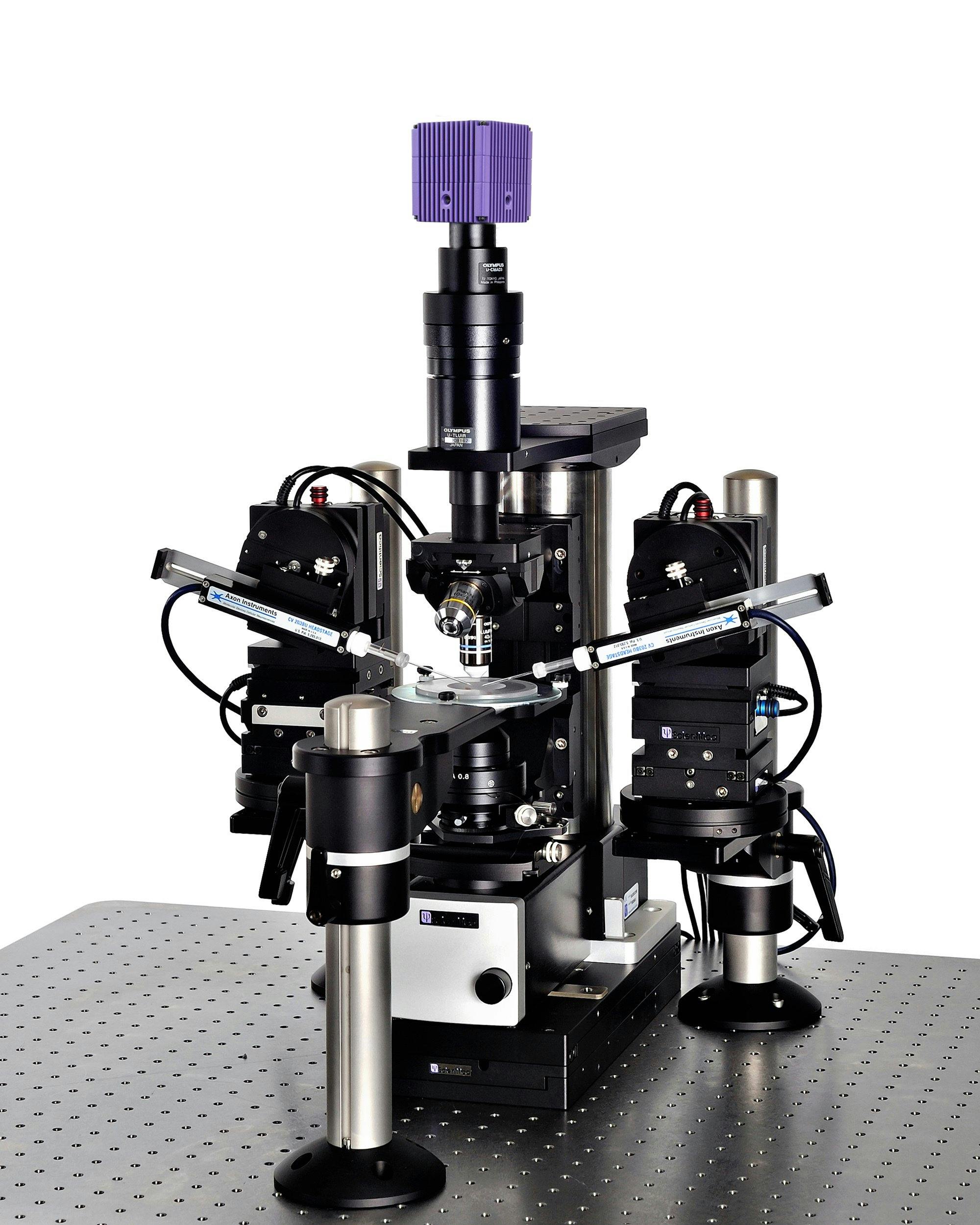
Scientifica SliceScope Pro 1000
An integrated electrophysiology system for patch clamp recording. The versatility of the system means that you can perform slice electrophysiology, fluorescent imaging, and in vivo experiments.